
Home » Beyond the PPA
Beyond the PPA

This model worked well for large corporates. But for SMEs and mid-market companies -organisations that need agility, quick deployment and solutions that support a full Net Zero strategy – PPAs increasingly fall short.

Green Tech FS’s Solar-as-a-Service, delivered within our Net Zero-as-a-Service (NZaaS) framework, retains all the benefits of “no CapEx solar” while solving the limitations that make PPAs unsuitable for today’s fast-moving businesses.
Why PPAs Became Successful
That clarity made PPAs an easy procurement decision – especially for corporates already used to long-term energy contracts. But the simplicity that drove early success also created structural limitations that now hold PPAs back.
The Limitations of PPAs
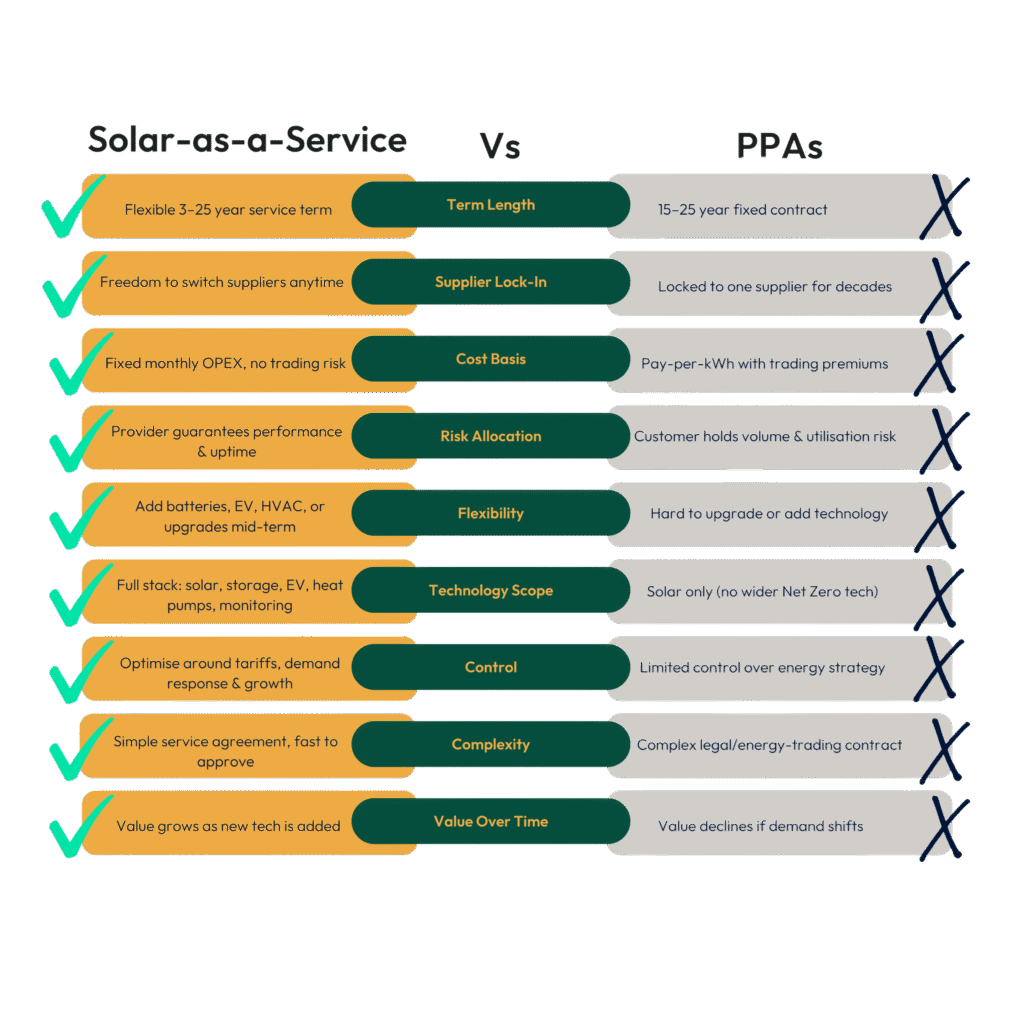
Long-term lock-in
PPAs tie customers to one supplier for up to 25 years, making it difficult to adapt to new tariffs, technologies or operational changes without penalties.
2. Only fund solar generation
PPAs finance solar PV - nothing more. They don’t support efficiency upgrades, battery storage, EV charging, heating electrification or monitoring tools, forcing customers into multiple contracts.
Customer holds key risks
Volume risk, utilisation risk and mismatch between generation and demand can all reduce the value of a PPA over time.
Complex and costly to negotiate
PPAs tie customers to one supplier for up to 25 years, making it difficult to adapt to new tariffs, technologies or operational changes without penalties.
Limited control
Asset upgrades, capacity increases, monitoring tools or operational changes must typically be approved—or funded—by the PPA provider.
Long-term lock-in
PPAs tie customers to one supplier for up to 25 years, making it difficult to adapt to new tariffs, technologies or operational changes without penalties.
2. Only fund solar generation
PPAs finance solar PV—nothing more. They don’t support efficiency upgrades, battery storage, EV charging, heating electrification or monitoring tools, forcing customers into multiple contracts.
Customer holds key risks
Volume risk, utilisation risk and mismatch between generation and demand can all reduce the value of a PPA over time.
Complex and costly to negotiate
PPAs tie customers to one supplier for up to 25 years, making it difficult to adapt to new tariffs, technologies or operational changes without penalties.
Limited control
Asset upgrades, capacity increases, monitoring tools or operational changes must typically be approved—or funded—by the PPA provider.
The Evolution: Solar-as-a-Service
Instead of paying for electricity, the customer pays a fixed monthly service fee that covers:
- Solar generation
- O&M and lifecycle management
- Real-time monitoring
- Performance guarantees
- Optional efficiency upgrades
The model is treated as OPEX, stays off the balance sheet, and can run for up to 25 years – matching PPA tenors while offering lower whole-life cost.
Because the finance is secured against the equipment – not energy trading – Solar-as-a-Service avoids hedging premiums and trading risk, reducing the cost to the customer by 10-20% compared to a like-for-like PPA.
Financial Clarity and Predictability
A typical corporate PPA price of £65–£85/MWh (6.5–8.5p/kWh) means a 2 MW system generating 2 GWh per year costs around £150,000 per year – locked in for the long term.
Solar-as-a-Service delivers the same output with:
- Lower annual cost
- No volume risk
- No supplier lock-in
- No exposure to energy-trading structures
Risk, Responsibility and Performance
Under Solar-as-a-Service, performance responsibility sits with the service provider -not the customer.
- GTFS and certified partners manage maintenance, optimisation and uptime
- Underperformance is resolved at our cost
- Funders receive secure receivables under a “hell-and-high-water” structure
- Customers receive guaranteed outcomes, not uncertain yield projections
This shifts risk away from the customer and ensures consistent performance throughout the contract term.
Visibility and Verification
Every system includes Eniscope for real-time metering and GINA, GTFS’s AI Sustainability Officer, for carbon reporting and performance insights.
This gives organisations:
- Transparent savings
- Verified emissions reduction
- Automated ESG reporting
- Insights that guide further improvements
Flexibility and Control
Solar-as-a-Service is designed for adaptability. Customers can:
- Switch grid suppliers at any time
- Optimise around smart tariffs
- Add new technologies mid-term
- Scale across multiple sites under one framework
- Expand capacity without renegotiating the original contract

Expanding the Opportunity: Storage, Carports and More
Once customers own the energy they generate – not the PPA provider – they unlock significant additional value.
Battery Storage
Stores excess generation, reduces import costs and supports peak-shaving and demand response.
Solar Carports
Add capacity without touching the roof, deliver visible ESG benefits and pair naturally with EV charging.
EV Charging Infrastructure
Supports fleet electrification and offers new revenue or staff-benefit opportunities.
Heat Pumps, HVAC Upgrades & Efficiency Measures
Reduce overall demand and maximise the impact of onsite solar.
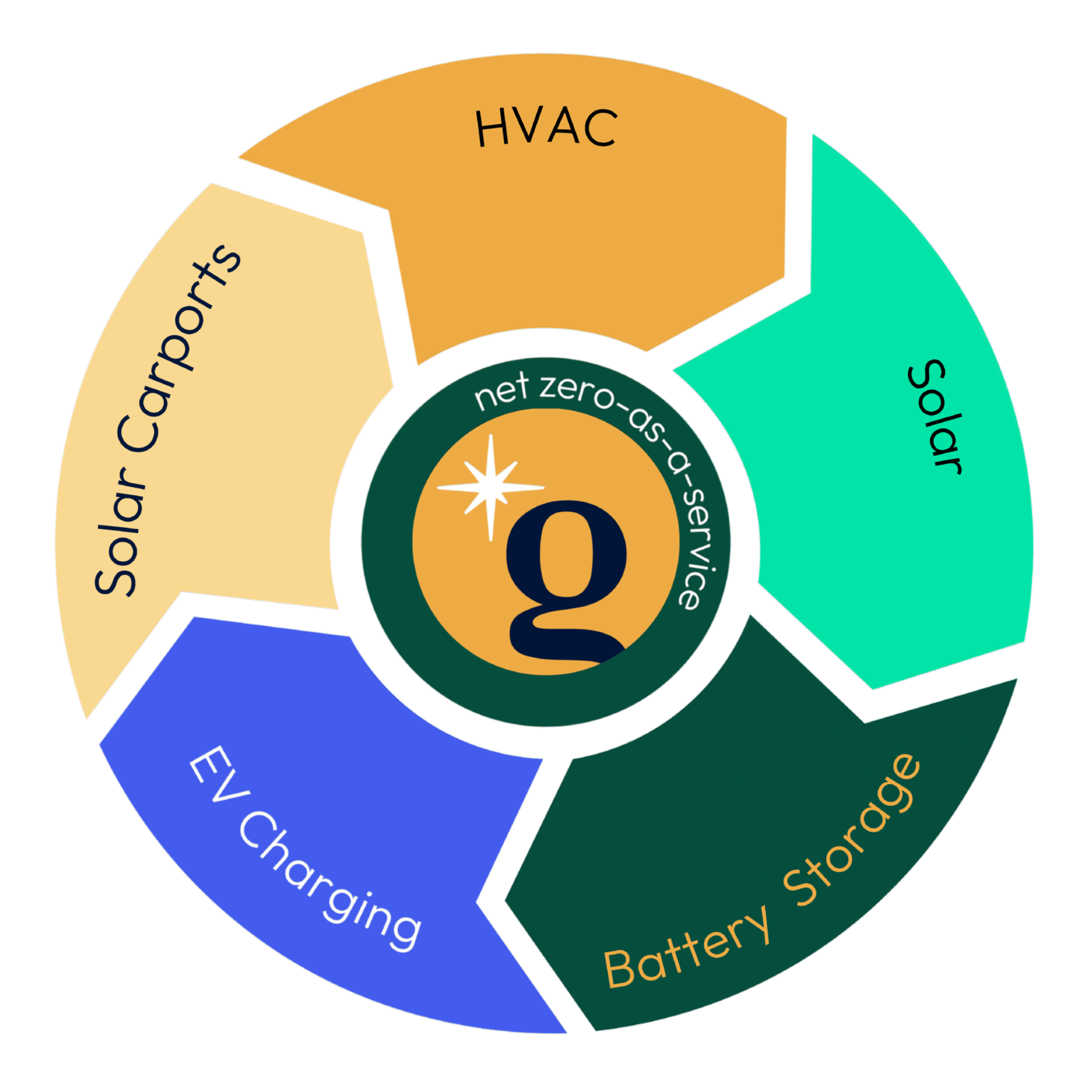
All of these can be added under NZaaS with no CapEx, simply by creating new Schedules under the existing service agreement.
This modular, scalable structure turns Solar-as-a-Service into a full Net Zero platform, not a one-off solar contract.
The Smarter Route to Net Zero
PPAs helped pave the way for renewable finance – but today’s businesses need solutions that are flexible, modular and integrated across the full Net Zero journey.
- The same long-term funding horizon
- Lower whole-life cost
- Full control and freedom of supply
- Integrated measurement
- Modular upgrades
- Scalable multi-technology capability
At Green Tech FS, our mission is to make Net Zero accessible, achievable and investable for every organisation.
Solar-as-a-Service doesn’t just power progress – it funds it.